Posts

John G. Jackson

Image
John G. Jackson In small rural towns and villages, it's probably cliche, but true, to say that pretty much everyone knows everyone else. I think to some extent 19th Century Mill Creek Hundred as a whole can be looked at in this way. With the myriad of familial ties running through it, I've often said that it can almost be thought of as a very spread out small town. This familiarity between residents only grows when you focus your view to an actual village and its surroundings. In this case, where almost no one is a stranger, there is often someone who seems to be even more well-known than everyone else. Over a period of about a half a century, that man in Hockessin was John G. Jackson. Joseph Lake called him "the most famous Victorian to live in Hockessin." John G. Jackson* was a native son of Hockessin, born into one of the largest landowning families there at the time. He was born in 1818 in the Dixon-Jackson House , which his grandfather James Jackson had pur...

Welcome to Anna Lee Huber!

Image
I'd like to extend a warm welcome to Anna Lee Huber, whose debut historical mystery, The Anatomist's Wife , hit the shelves yesterday.  Here's the official blurb: Scotland, 1830. Following the death of her husband, Lady Darby has taken refuge at her sister's estate, finding solace in her passion for painting. But when her hosts throw a house party for the cream of London society, Kiera is unable to hide from the ire of those who believe her to be as unnatural as her husband, an anatomist who used her artistic talents to suit his own macabre purposes. Kiera wants to put her past aside, but when one of the house guests is murdered, her brother-in-law asks her to utilize her knowledge of human anatomy to aid the insufferable Sebastian Gage-a fellow guest with some experience as an inquiry agent. While Gage is clearly more competent than she first assumed, Kiera isn't about to let her guard down as accusations and rumors swirl. When Kiera and Gage's search leads the...

Feel the love with ROYAL ROMANCES

Image
My fourth nonfiction "royal" book for NAL, ROYAL ROMANCES , Titillating Tales of Passion and Power in the Palaces of Europe , releases today! More breathtaking than any fairy tale, here are seven scandalous, seductive centuries of all-for-love royal desire . . . Elegant palaces, dazzling power plays, shimmering jewels, and the grandest of all-or-nothing gambles—nothing can top real-life love among the royalty. Louis XIV defied God and law, permitting his married mistress Madame de Montespan to usurp the role of Queen of France, then secretly wed her successor, Madame de Maintenon. Grigory Potemkin was a worthy equal in Catherine the Great’s bed as well as in Russia’s political arena. Dashing Count Axel von Fersen risked everything to save Marie Antoinette’s life more than once—and may have returned her passion. The unshakable devotion of the beloved late “Queen Mum” helped King George VI triumph over his, and England’s, darkest hours. And the unpretentious, timeles...

A Lesson from My Daughter

Image
I'm writing this from my hotel room in Ashland, Oregon, on an autumn weekend trip to see a wonderful Troilus & Cressida and Romeo & Juliet for a second time. So I'm again returning to a post I originally wrote for my own blog, with a few embellishments. In my WIP, Malcolm and Suzanne have a second child, Jessica. I set the book in October 1817 with Jessica ten months old, so that at one point at least while I was writing it, she would be the same age as my daughter MĂ©lanie. For once I wouldn’t have to try to remember what my friends’ kids were doing at the particular age of the children in my books or ask my friends to remember age-appropriate details only to be told it was all a blur. So this month, the parental wonder of watching of a child’s growth and development has had an added focus for me. I’ve written scenes with Suzanne nursing while I’ve nursed myself. I’ve sat in the play park and taken notes on my iPad or my phone about how Mel pulls herself up o...

Pictorial Felicity

Image
Every now and again, I'll run into one of my heroes or heroines on the wall somewhere.  Usually, it's well after I've already created them.  There will be a thrill of recognition at seeing just that right person in just that right time period. This happened to me in Paris when I was researching my eighth book, The Orchid Affair .  I'd gone to an exhibit at the Musee Cognac Jay on Marguerite Gerard.  I can't remember exactly what it was called.  Something along the lines of "Marguerite Gerard: artiste en 1789".  My book was set in 1804, but an important part of the back story involved my hero's dead wife, who had been an influential painter who rose to prominence during the Revolution.   And wouldn't you know it.  I walked in and found a sketch of Andre, my hero, just as he must have looked in 1789.  Of course, it wasn't actually Andre.  In real life it was Anne-Louis Girodet-Trioson.  That didn't matter.  I knew who it was. The...

The Epicure’s Almanack

Image
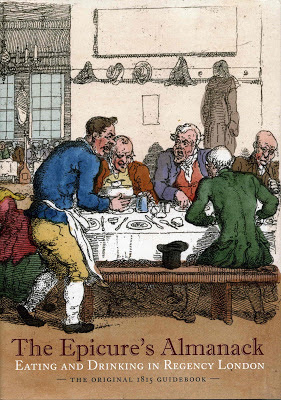
Yes, I have a new research book…one I’m really enjoying. It’s The Epicure’s Almanack (1815) edited and annotated by Janet Ing Freeman. The introduction alone was nearly worth the rather hefty price. It included basic information I’d never known or understood before, such as what it means for a business to be a “house”, “tavern”, or “shop”. “Shops” don’t have designated space for eating, but are only for “take out”. “Taverns” (as opposed to public houses) are dedicated to wine, not beer and ale. Many—indeed it would appear most—coffee shops and pubic houses also kept rooms that people could hire, and were in fact, a form of inn or hotel.  A few favorite tidbits: John o’Groat’s, near modern Piccadilly Circus, had tables laid ready for dining (cloths, silverware, glasses, and even had a priced menu on the table just like what we’re used to today.  You could get a curry in London as early as 1773 (at the Mistress of Norris Coffee-House in Haymarket), and there was even a curry ho...

Perfect freedom of action

Image
Lively St. Lemeston, the small Sussex market town at the heart of my next two (at least) books, is the first town I've written about. In for a Penny takes place on a country estate, and A Lily Among Thorns is set in London. But towns were becoming more and more important in England during the Regency as the balance of the economy shifted, with more jobs being created in industries and jobs in agriculture being lost. Of course there were the great factory towns (most of them in the North of England) like Manchester, and London itself increased greatly in size in the period, but even small towns saw growth and change. One thing I learned was that "town" covered a huge range of sizes. ("City" had a pretty specific meaning in period: a town with a cathedral, that is, the center of a Church of England see, and didn't really denote anything in terms of size.) I imagine Lively St. Lemeston having a population of about 1500. But what I have to remember is that tha...