Posts

Time is but the stream I go a-fishing in

I'm working on the second book in my Lively St. Lemeston series, Crimson Joy , and I just did something that I've done before, that I'll probably do again, and that I always feel conflicted about: I'm stealing a story. I'm taking something that happened to a real person, and giving it to my heroine. In this case, it's this anecdote, cited in a footnote of Electoral Behavior in Unreformed England , concerning “treating,” or the practice of patrons providing free food and drink for electors prior to a poll. I had a vague recollection of this anecdote... he ran out of ale, so he opened up his expensive French brandy?  I couldn't remember where I'd seen it, but I thought I might have posted it on my blog. After backreading for half an hour, I almost gave up. I don't need the real anecdote,  I thought. It's fiction. Maybe I can improve on it, make it even better than the real thing. Then I found the real thing. There is no improving on this. This is p...
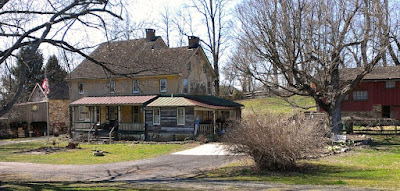
The David Wilson House

Image
A short while back I made mention of the fact that for the foreseeable future I'd be having less time to research and write the blog. I also mentioned the possibility of "Guest Posts", if anyone had anything they knew about or were researching, and felt like sharing. After all, that's how this blog started -- I was doing my own research for fun and decided to find a way to share what I'd found with anyone who might be interested. I'm happy to say that I've already received several responses, and this post represents the first such Guest Post on the MCH History Blog. It was written by Dave Olsen, who often runs across lost history, off the beaten path (literally). He's the one who showed me the Plumgrove Farm ruins last year. Here's what he came up with: The David Wilson House While running earlier this past winter, I happened to turn off of Brackenville Road into Hockessin Valley Falls .   As I headed around the outside loop of the neighborhood...

The American crisis

   One of the greatest accounts of the last Atlantic crisis, or fourth turning, are the first two volumes of the diaries of Harold Nicolson, covering the years 1931-9 and 1939-45, respectively.  They were brilliantly edited and published by his son Nigel in the late 1960s and I have returned to them many times. Nicolson, like his father, was a leading figure in the British Foreign Office who left his position in 1931, when he was still in his forties.  Ironically, he did so for the reason so often cited by disgraced American officials today: to spend more time with his family.  His family by then was of a somewhat unusual kind, since he and his wife, the author Vita Sackville-West, had after the birth of their two sons both turned to homosexuality, but they were intensely devoted to one another emotionally all the same.  Until her death in the early 1960s she lived at their country house, Sissinghurst, while he worked in London as a journalist and, from 193...

Limbaugh versus the truth

   I want to be the first person to break this story.    I do not listen to Rush Limbaugh but I check his transcripts from time to time.  On Tuesday, I found this :    "We all owe a debt to a smoker.  A guy in his house wanted to smoke a cigarette.  His wife would not let him smoke the cigarette inside.  So he went out in the backyard, and while he was smoking his cigarette he's looking at his boat.  And he said, "There's something strange about that boat."  Something didn't look right.  It was his boat, so he climbed up on his boat while he's out in the backyard smoking a cigarette, he unzips the protective winter cover that he has on his boat, and he sees the bleeding, half conscious Boston Marathon Muslim bomber.  Remember that old saying, for the want of a nail the kingdom was lost, something like that? "This guy wants a cigarette.  We hate cigarettes.  We hate smokers.  But, if not for th...

Spies, Loyalty, Betrayal, & the Napoleonic Wars

Image
Recently, I did a very fun interview on Word Wenches with the wonderful Cara Elliott/Andrea Penrose about the release of The Paris Affair . Cara asked some wonderful questions, in particular about the themes of loyalty and betrayal that run through my books and why I chose the Napoleonic Wars as a setting for those stories. As often happens, those interview questions caused me to mull over things in my books. I've been thinking about it a lot in and around promoting The Paris Affair , finishing my WIP, and getting ready for the Merola Opera Program's annual Benefit (where I am with Mélanie above). I first gravitated to the Regency/Napoleonic era through my love of Jane Austen and Georgette Heyer. But I also love spy stories, both James Bond adventure and the sort of intricate chess games and moral dilemmas John le Carré dramatizes so brilliantly. The Napoleonic Wars offers are a wonderfully rich setting for both types of story. So many different sides, so many different f...

The Boston bombs

I have been travelling for the past three days. This post was drafted last Thursday morning, before the shootout and the arrests.  As it turns out, my instincts were more right than wrong.  While evidence is emerging that the bombers were also inspired by jihadis overseas, they evidently were not part of an organized group.  Had they been, I think they would have fled the country at once.  The last paragraph also seems to have been unduly alarmist, since Pakistan is not involved and the Russian government was more concerned with the two suspects--or at least one of them--than our own was.  See the other new post from this weekend, below. Three people are dead, and dozens are injured. One can only tentatively speculate before more hard information is available, but I"m afraid this is the beginning of a new and dangerous phase in our war with radical Islam. I do not intend what follows to be inflammatory, and it may be proven wrong at any moment. It is my ...

The Isaac Flinn House

Image
There was a picture I had seen a while back (shown at right) that had piqued my interest, but I hadn't gotten around to writing about it until now. The only clue to go on in the quest to figure out where it might have been was the caption attached to the picture, which reads -- " Isaac Flinn House, Price's Corner, Wilmington, Delaware, 1890's. Isaac Flinn and his family pose inside the gates in front of their home. The house had served as an inn about the time of the American Revolution. " Obviously, the mention of Price's Corner caught my eye, and while that meant it was probably a bit outside of MCH, it was close enough to interest me. Since the house didn't look like anything I recognized as standing today anywhere near Price's Corner, the only clue to go on was the name "Isaac Flinn".  The Flinn family has been in the region for quite a while, and was prominent in the 19th Century in a broad swath from Newport to Greenbank. The name shows...